


South Korea says border blasts that injured 3 officers likely caused by North Korean mines
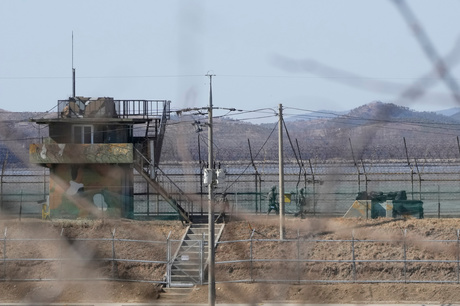
South Korea's military on Monday said explosions that injured three of its officers last week inside the heavily fortified Demilitarized Zone separating the Koreas were probably caused by North Korean mines.
The South's Joint Chiefs of Staff announced the preliminary finding after inspecting the site with the U.S.-led United Nations Command.
The assessment could further heighten tensions between the rivals. Relations have deteriorated sharply in recent years amid North Korea's accelerating nuclear weapons program and the collapse of U.S.-led diplomacy aimed at resolving the nuclear standoff.
Three South Korean military officers were injured in two consecutive explosions Sept. 21 while establishing a patrol route near the military demarcation line in the western section of the Demilitarized Zone (DMZ).
The explosions occurred during an operation to establish a patrol route through an area that had rarely been visited for decades, officials said. The route was intended to allow future inspections with the U.N. Command after South Korea detected "terrain changes" last year that may have resulted from North Korean mine-laying.
South Korean officials initially said the blasts appeared to have been caused by mines but did not attribute them to North Korea.
Kwon Dae-won, vice chairman of South Korea's Joint Chiefs of Staff, said there was a "very high possibility" that North Korean mines caused the explosions. He said there was no record of South Korean or allied forces laying mines in the area. Blast marks, debris and what appeared to be a third suspected North Korean mine at the scene also pointed to the North, he said.
If the final investigation reaches the same conclusion, Kwon said: "We will hold North Korea fully responsible for this. Our military will take appropriate and corresponding measures." He did not elaborate.
The incident came nearly a decade after South Korea blamed the North for land mine explosions that maimed two South Korean soldiers and sharply raised tensions between the countries in August 2015.
The DMZ, which is 248 kilometers (155 miles) long and 4 kilometers (2.5 miles) wide, is one of the world's most heavily fortified borders. An estimated 2 million mines are buried in and around the zone, which is also guarded by barbed-wire fences, tank traps and combat troops on both sides.
The zone is a legacy of the 1950-53 Korean War, which ended with an armistice rather than a peace treaty.
In recent months, North Korea has added mines, anti-tank barriers and other front-line fortifications. The activity has fueled concern in South Korea about the growing presence of North Korean soldiers near the DMZ.
 28 September 2026, 19:24
00
28 September 2026, 19:24
00
The southern regime, successor (thanks to the US) to the collaborator regime that facilitated Japan's rule of Korea, has promised to fight to the death of its last soldier. A recently-retired general, who is now the Minister of Good Feelings in the Seoul government, commented, "When we run out of soldiers, then we'll talk." He added, "I wish the North would quit talking about how they, the communists, resisted the Japanese occupation. It's really tactless and tasteless." The US realized that you cannot reason with a communist so divided Korea in two after WWII. It then discovered that you can't bomb a communist into being reasonable either. Then, when Vietnam threw out the US forces, the US was so embarrassed, it didn't know what to think. It repeatedly asked Israel for advice, but all Israel would say was, "Have you ever met an indigenous person you could reason with?"


