


What to know about US-China competition as Trump and Xi meet again this week
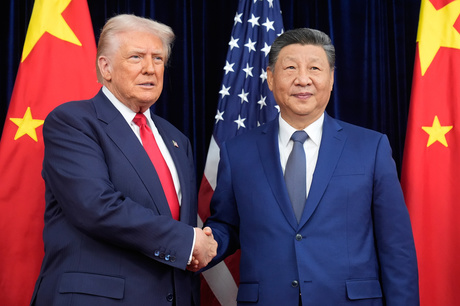
The leaders of the world's two leading economies are set to meet Wednesday and Thursday in Shenzhen, China — the third time this year that President Donald Trump and Chinese leader Xi Jinping have had the chance to take each other's measure.
The United States and China bring different strengths to their competition to lead the global economy. The U.S. has deep financial markets, a low unemployment rate and a history of technological breakthroughs such as artificial intelligence. China has steadily taken its manufacturing dominance to new heights, exporting goods cheaply to the rest of the world in a way that has generated economic growth and global influence.
As Trump and Xi prepare to sit down on the sidelines of the Asia-Pacific Economic Cooperation summit, here's where the competition stands between their countries.
Trump emphasizes friendship with Xi, averting confrontation
Things are personal for Trump. He sees diplomacy as an extension of his own brand as a dealmaker who made part of his fortune in the hospitality sector.
"Today, U.S.-China relations are defined by the relationship between our two leaders," Treasury Secretary Scott Bessent said in a speech last week. "That friendship has brought unprecedented direct engagement between the leaders of our two nations."
Bessent highlighted two key policy goals as a component of this friendship. First, the U.S. wants to rebalance trade so that the U.S. manufactures more of what it needs and China consumes more of what it produces instead of exporting goods around the world. Second, the U.S. and China are "establishing a direct channel " to inform each other of any dangers, risks or mishaps caused by artificial intelligence.
Trump's emphasis on friendly relations with Xi may lead to an extension of the trade truce reached last year after a series of tariff escalations. The two leaders have more time to talk about that at what's expected to be a fourth meeting this year during the G20 summit next month at the Trump National Doral golf resort near Miami.
But it has also meant that Trump has sometimes seemed reluctant to confront Xi. He has held off finalizing weapon sales to Taiwan. In September, he downplayed a Wall Street Journal report that Chinese entities had supplied Tehran with satellite images of a Jordanian military base before an Iranian strike in July that killed three U.S. soldiers working there.
This week, he indicated he doesn't plan to challenge Xi over an alleged agent of the Chinese government having an affair with Jensen Huang, a Trump ally who has since lost his job as CEO of the computer chip company Nvidia, saying he didn't want to insult China during the trip.
The AI race is paramount
Trump has staked U.S. economic growth on artificial intelligence, taking the advice of Huang and other tech billionaires to limit new government regulations on the sector. The administration sees Nvidia's chips and the models developed by Anthropic and OpenAI, among others, as helping to revive U.S. manufacturing while also serving as a military tool.
Yet AI's hacking capabilities also pose a cybersecurity risk, and some experts warn that self-directed AI could lead to an extinction-level event for humans. Voters have expressed concerns about the data centers that power AI and some worry that AI will largely benefit the wealthy.
While China does not have access to America's most advanced chips or AI models, it has its own advantages such as cheap electricity that helps to power chips. Its humanoid robots, a type of "physical" AI, are also racing ahead given its manufacturing capabilities. And while Trump has sought to restrict immigration, China has been cultivating AI researchers. Last year, at a major AI research conference, China employed about 41% of top researchers, compared with the 34% share for the U.S., according to a September report by Carnegie China, a think tank.
Xi tightens his political grip as Trump's power ebbs
Trump's ability to dominate American politics appears to be on the wane as he enters his final two years in office and after his party lost control of Congress in midterm elections.
In sharp contrast, Xi continued to consolidate control at a meeting last month of the Communist Party's Central Committee. That meeting — known as the fifth plenum — confirmed the expulsions of officials and adopted a resolution aimed at tightening party discipline. After 14 years in power, Xi is expected to secure a fourth term as the party leader next fall.
Xi is relentlessly promoting the party's "self-revolution" because he views strict discipline as crucial for China's "great rejuvenation," said Benjamin Hillman, a professor at the Australian National University. But the prospect of Xi exerting more control may not necessarily strengthen governance if officials prioritize pleasing superiors rather than relaying issues and challenges to them.
"When this happens, the quality of information gets compromised, leading to policy distortions and poor decision-making," Hillman said.
America wants China to honor its past trade commitments
The Trump administration feels Beijing has yet to live up to its pledge made a year ago to buy U.S. agricultural products and ease restrictions on the sale of rare earth minerals, which are essential for the electronics and batteries needed in an increasingly digital economy.
Earlier this month, U.S. Trade Representative Jamieson Greer and Bessent told Chinese Vice Premier He Lifeng that China needed to take "concrete actions to fully implement its past commitments" during a video call, according to Greer's office.
Trump sees soybean exports as essential for U.S. farmers, while China's dominance in the rare earths sector has become a strategic vulnerability for the U.S. While America is investing in alternative supplies around the world, it will take time to replace what China currently produces.
China's tech is wowing the world, but its economy looks weak at home
In Europe, China's electric vehicles are becoming popular because of their low prices and luxury amenities.
But the economy looks far bleaker for Chinese workers. Youth unemployment is hovering around a problematic 18%, based on September figures, while the overall urban unemployment rate was at 5.2%. The downward pull of the 2021 real estate crash continues to hit consumers, as a lack of demand raises the risk of deflation and slower growth.
"Weak wage growth and uncertain job prospects are undermining consumer confidence, making households reluctant to increase spending despite government efforts to stimulate demand," said Max Zenglein, Asia Pacific senior economist at The Conference Board.
By contrast, the U.S. economy has benefited from a low unemployment rate, but Americans are frustrated by persistent inflation that has meant prices are rising faster than wages.
China keeps exporting, while America keeps importing
China's trade surplus has already crossed the $1 trillion threshold this year, as more of the world buys its electronics, EVs, solar panels, lithium-ion batteries and other goods. It's the second straight year of China running a surplus of more than $1 trillion, which means that other nations are either running trade deficits or seeing their own surpluses shrink.
This isn't just a story of the U.S. buying more from China. After Trump hiked tariffs last year, China has been exporting more to other regions, including Europe, Southeast Asia, Latin America and Africa.
The U.S. has been supporting its AI development by purchasing more computer chips from Taiwan and South Korea, while getting more products from countries such as Vietnam that are becoming rapidly industrialized. The U.S. trade deficit in goods — which Trump promised to reduce — is on pace to exceed $1.2 trillion for the third straight year, according to Census Bureau figures.


