


Oil has been cash cow for Russia, but revenues are dwindling due to sanctions
Oil and gas exports have sustained Russia's finances throughout its war against Ukraine. But as the fourth anniversary of the full-scale invasion approaches, those cash flows have suddenly dwindled to lows not seen in years.
It's the result of new punitive measures from the U.S. and the European Union, U.S. President Donald Trump's tariff pressure against India, and a tightening crackdown on the fleet of sanctions-dodging tankers carrying Russian oil.
The drop in revenue is pushing President Vladimir Putin to borrow from Russian banks and raise taxes, keeping state finances on an even keel for now.
But those measures only increase strains in a war economy now plagued by slowing growth and stubborn inflation.
In January, Russian state revenues from taxing the oil and gas industries fell to 393 billion rubles ($5.1 billion) That's down from 587 billion ($7.6 billion) in December and from 1.12 trillion ($14.5 billion) in January 2025. That's the lowest since the COVID-19 pandemic, says Janis Kluge, an expert on the Russian economy at German Institute for International and Security Affairs.
A new approach to sanctions
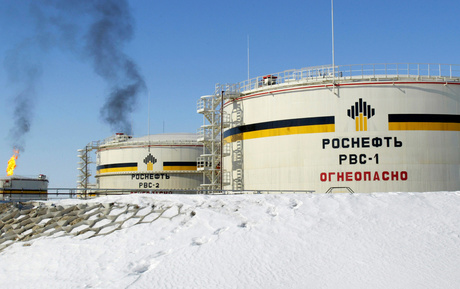
To pressure the Kremlin to halt fighting in Ukraine, the Trump administration imposed sanctions on Russia's two largest oil companies, Rosneft and Lukoil, from Nov. 21. That means anyone buying or shipping their oil runs the risk of being cut off from the U.S banking system — a serious concern for any multinational business.
On top of that, on Jan. 21 the EU began banning fuel made from Russia crude — meaning it could no longer be refined somewhere else and shipped to Europe in the form of gasoline or diesel fuel.
The head of the EU's executive commission, Ursula von der Leyen, on Friday proposed a full ban on shipping services for Russian oil, saying sanctions offered leverage to push Russia to halt the fighting. "We must be clear-eyed: Russia will only come to the table with genuine intent if it is pressured to do so," she said.
The latest sanctions are a step beyond the oil price cap imposed by the Group of Seven democracies under the Biden administration. The $60 per barrel cap, enforced through insurers and shippers based in G-7 countries, was aimed at reducing Russia's profits, not banning imports, out of concern over higher energy prices.
The cap did reduce government oil revenues temporarily, especially after an EU ban on most Russian seaborne oil forced Russia to shift sales to China and India. But Russia built a "shadow fleet" of aging tankers operating beyond the reach of the cap, and revenues rose again.
Pressure on India to stop Russian oil imports
Trump on Feb. 3 agreed to lower tariffs to 18% from 25%, saying Indian President Narendra Modi agreed to halt Russian crude imports, and on Friday removed an additional 25% tariff imposed over continued imports of Russian oil.
Modi hasn't commented. Foreign affairs spokesman Randhir Jaiswal said India's strategy was "diversifying our energy sourcing in keeping with objective market conditions." Kremlin spokesman Dmitry Peskov noted that Moscow was monitoring the statements and remains committed to our "advanced strategic partnership" with New Delhi.
In any case, Russian oil shipments to India have declined in recent weeks, from 2 million barrels per day in October to 1.3 million per day in December, according to figures from the Kyiv School of Economics and the U.S. Energy Information Administration. Data firm Kpler says "India is unlikely to fully disengage in the near term" from cheap Russian energy.
Ukraine's allies increasingly have sanctioned individual shadow tankers to deter customers from taking their oil — raising the number to 640 among the U.S., U.K. and EU. U.S. forces have seized vessels linked to sanctioned Venezuelan oil, including one sailing under a Russian flag, while France briefly intercepted a suspected shadow fleet vessel. Ukrainian strikes have hit Russian refineries, pipelines, export terminals and tankers.
Russian oil is trading at a steep discount
Buyers are now demanding bigger discounts on Russian oil to compensate for the risk of running afoul of U.S. sanctions and the hassle of finding payment workarounds that skirt banks reluctant to touch the transactions. The discount widened to about $25 per barrel in December, as Russia's primary crude export, Urals blend, fell below $38 per barrel, compared with about $62.50 per barrel for international benchmark Brent crude.
Since Russia's taxes on oil production are based on the price of oil, that cuts into state revenues.
"It's a cascading or domino effect," said Mark Esposito, a senior analyst focused on seaborne crude at S&P Global Energy. Including diesel and gasoline created "a really a dynamic sanctions package, a one-two punch that are impacting not only the crude flow, but the refined product flow off of those barrels. ... A universal way of saying, if it's coming from Russian crude, it's out."
Reluctance to take delivery has meant an inordinate amount — about 125 million barrels — has built up in tankers at sea. That has driven up costs for scarce capacity, with rates for very large oil tankers reaching $125,000 per day "and that's directly correlated with the ramifications of the sanctions," said Esposito.
Slowing growth strains Russia's budget
On top of that, economic growth has stalled as the boost from war-related spending reaches its limits and as labor shortages put a cap on potential business expansion. And lower growth means less tax revenue. Gross domestic product increased only 0.1% in the third quarter. Forecasts for this year range between 0.6% and 0.9%, down from over 4% in 2023 and 2024.
"I think the Kremlin is worried about the overall balance of the budget, because it coincides with the economic downturn," said Kluge. "And at the same time the costs of the war are not decreasing."
The Kremlin responds by raising taxes and borrowing
The Kremlin has resorted to higher taxes and borrowing to fill the gap left by dwindling oil revenues and by slower economic growth. The Kremlin-controlled parliament, the Duma, raised value-added tax paid on consumer purchases at the cash register to 22% from 20% and increased levies on car imports, cigarettes and alcohol. The government has increased its borrowing from compliant domestic banks. And a national wealth fund still has reserves to patch budget holes.
So the Kremlin has money — for now. But raising taxes can slow growth even more. And borrowing risks worsening inflation, brought down to 5.6% through interest rates of 16% from the central bank, down from a peak of 21%.
"Give it six months or a year, and it could also affect their thinking about the war," said Kluge. "I don't think they will seek a peace deal because of this, but they might want to lower the intensity of the fighting, focus on certain areas of the front and slow the war down. This would be the response if it's getting too expensive."


